
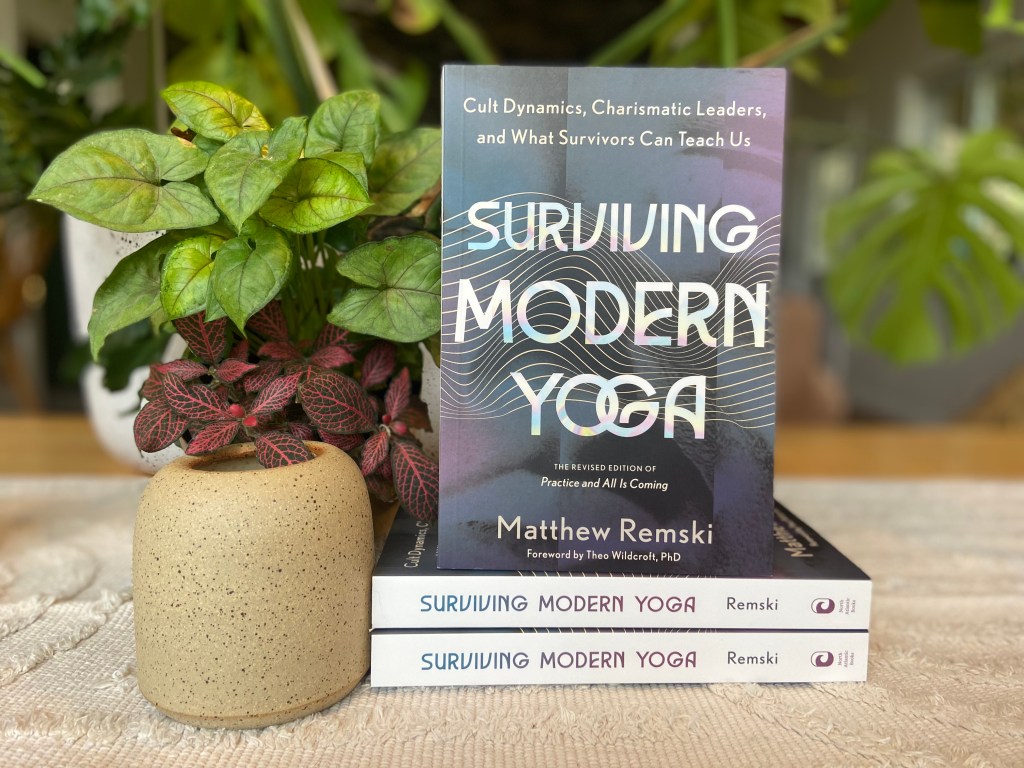
We spoke with American yoga teacher, journalist, author, and podcaster Matthew Remski on the occasion of the re-edition of his book Surviving Modern Yoga a revision of his previous work Practice and All is Coming (en référence à la célèbre phrase prêtée à Pattabhi Jois, le fondateur des séries de l’Ashtanga) et préfacée par la chercheuse Theo Wildcroft. Cet ouvrage sous-titré « Cult Dynamics, Charismatic Leaders, and What Survivors Can Teach Us » (« dérives sectaires, leaders charismatiques et ce que les survivants peuvent nous apprendre ») est construit comme une enquête, étayée par de nombreux témoignages, sur les abus physiques et sexuels perpétrés par le fondateur de l’Ashtanga yoga Pattabhi Jois et une analyse des structures et mythes qui les ont rendues possibles.
In parallel, he co-hosts Conspirituality, where he examines New Age cults, pseudo-sciences, and the authoritarian extremism dispensed by spiritual frauds, as well as the culture of "conspirituality" (the intersection of spirituality and conspiracy theories). He points out the cognitive dissonances and spiritual illusions at work in the world of yoga and wellness, putting them in perspective with the excesses of capitalism and the resulting inequalities. Now living with his family in Toronto, Matthew also writes articles, fiction, and poetry, and offers his own classes and trainings focused on awareness, inclusivity, and repairing the abuses he denounces.
Citta Vritti I You have just published Surviving Modern Yoga(which is a reedition of your former book Practice and All is Coming, 2019). Practice and All is Coming It highlights abuse and cult dynamics within the modern yoga world. What are the main factors that explain the omnipresence of such dynamics? Can we say those abuses are “systemic”?
Matthew Remski : I absolutely agree because when you look at the record there are very few medium to large scale organizations that do not have unresolved abuse histories. The list is very long. And I think the origin point of this comes out of the model of charismatic control, influence and organization. The post war period of yoga globalization was fueled by some very remarkable yoga entrepreneurs coming from India, who met North American primarily and then also a European audience that was disenchanted with institutional roots to social change and felt that the real lessons were that power can only really be confronted internally. The gurus met groups of drop-out, white, lower-to middle-class, and some upper-middle class people who didn't really know what to do with their lives. The promises of the 1960s had faded. The new economies of the 1970s were taking shape. There was this spirit of openness and emptiness around the purpose and the meaning of life socially and culturally.
They turned to the self project. And the primary models for the self project are the largest selves on offer, which are people who begin to be taken as gurus, who embody within themselves some kind of eternal and complete knowledge to which one could be devoted and therefore find a pathway towards liberation. And unlike institutional forms of learning, which would require standards, peer reviews, ethic committees, ways of doing things, there were no rules for the 1970s and 1980s yoga gurus to follow. It was and still is a completely unregulated industry, in which charisma and very idealistic promises are the gold currency. So, we have a combination of things: a deracinated audience, and fiercely charismatic and driven yoga entrepreneurs, who brought with them not only the ideas of orderliness and purification from aspects of yoga culture, but also aspects of political conservatism from the nationalistic movements that they had grown up in. That is something that was completely obscured from most North American and European yoga people. They did not realize that Mr. Iyengar, Mr. Jois, Bikram Choudry basically grew up being educated in body fascism. Somehow I think because they were Indian, many did not pick up on the fact that they were actually very conservative, misogynistic, anxious people. And they were not really interested in how you felt in your body, or in therapy or healing, they were interested in correct behavior and alignment. I think that the systemic nature of abusive relationships in the yoga world is really a perfect storm of all of these influences. A lack of regulation, a lack of institutional cohesion or oversight, the prominence of the charismatic teacher, and then a physical discipline that is based on what I call “somatic dominance”. When you say it out loud, it seems like it is completely antithetical to what most people believe is or should be going on in a yoga class, but that is where they were coming from. And that is why they injured so many students. That is why they turned so many students into people who were relentlessly anxious about how well they were performing asanas.
I found it very interesting in your book that you observed that the same gurus were inflicted exactly the same kind of pain from their own teachers and gurus and how generally the atmosphere of the colonial period was very much around corporal punishment and obedience.
Yes. This is very important. The notion of physical discipline and punishment as a dominating tool of pedagogy, parenting, and forming the state are all essential to the way in which modern yoga takes its form. Prior to 1929, people were practicing yoga on their own, through verbal, one on one instruction, without much concern for alignment. Alignment is all about surveilling the body from the outside and correcting it. And that's bound up in whether or not the teacher identifies flaws as they look at you and the way in which those flaws were corrected - going back to the days of Krishnamacharya, it was through beating. There are open accounts of B.K.S Iyengar and Pattabhi Jois as young boys talking about being beaten by Krishnamacharya. This does not make him an evil person: he doesn't stand out in terms of what is happening in that time period. The history of corporal punishment becomes integral to the way in which the body is supposed to be oriented correctly in space : corporal punishment moves into adjustments, there's no real clear break there. Then it goes through a series of dilutions to the point where if somebody is learning trikonasana from an Instagram influencer they will mirror that in a way that is not about being directly dominated, but about internalizing the demands of the visual posture. These influences are still with us and they are intergenerational. People are smarter about the difference between teaching and physical assault, but somehow there is the same feeling that the body is an object that has to be organized correctly in order to be virtuous. That is a lasting legacy.
You are also famous for your Conspirituality podcast which examines the important permeability of conspiracy and far right theories in the spiritual realm; how do you explain this phenomenon ?
Politically, I think the best term is “diagonalism”: instead of the theory suggesting that the aims of left wing people and right wing people are so similar that they would meet at some point, diagonalism suggests that there is a political space to occupy that is primarily committed to the notion of personal freedom: it is libertarian. I think that is at the root of understanding how the yoga and wellness world during the pandemic began to be captured by right wing ideologies. The basic premise was depoliticized and hyper individualistic, and the reason that it so easily captured the yoga world is that from the sixties and seventies, yoga people were told by their gurus that politics was useless, that voting was low vibration, that being interested in social programs was going to contribute to moral weakness and that all the tools for your salvation were located inside oneself. Within the yoga world it is said you can not actually fix anything in the world because the world is not quite real. What is real is your internal sensations, what is real is your revelation, what is real is what you see in your meditation every morning and this is what you should look for. That is the general basis which is not progressive or conservative: it is checked out and individualistic. The problem is that this space can be quickly and easily colonized by ideas that people have to protect their hyper individualistic spiritual paths. Fast-forward to 2020, and, contrary to the advice of public health officials, yoga people can start to believe that should take care of their health against Covid by doing deep breathing. They should boost their immune system by doing asanas and taking ancient herbs. They should avoid medical interventions that their gurus do not approve (like not taking vaccines and so on). “Equanimity” is the idealized form but it is really not giving a shit anymore about the society they live in. It is very interesting that Satchidananda would start the Woodstock festival by saying “this is the time for peace and harmony and let's open this festival with Aum”. It was in 1969 and the protest movements died out pretty quickly after that. People see Woodstock as being a sort of counter cultural celebration but it was actually on the verge of a reactionary backlash as well.
Many of the modern complaints are not without merit, especially in America where the medical system is abusive. It is true that large agricultural movements have created monocultures and degraded soil life and so on. So there are always good reasons for thinking that way, it is always harder to get people to think about a complex way and to express solidarity towards each other. Yoga communities are not big on expressing solidarity. Most yoga people do not believe in class. There is this presumption of perfect equality that is already in place and that really inhibits people from working harder.
So there is a symmetry between the yoga guru that emerged between the seventies and eighties and the messianic influencer who is telling you on Facebook in 2020 that their herbs or their breathing practices are boosting their immunity: the structure is the same.

How politicized is the spiritual community in North America today ?
I think for the most part mainstream yoga and Buddhist spirituality has remained pretty stable in its centrism and its depoliticization. The pandemic has radicalized some groups on either end of the spectrum. More on the left I would say that on the right. I see more in progressive yoga spaces, around ideas like decolonisation or anti caste politics or community care or trauma sensibility or disabilities studies … That is very vibrant - I do not say it is large, I do not have any number - but it is a vibrant component of yoga in alternative spirituality. And that was not so prominent five years ago and certainly not ten years ago. Ten years ago people started talking about racism in yoga. People started to talk about the intersection between globalization of yoga and colonial politics. But now there is a lot of energy amongst people who are really trying to look at yoga as a contemplative practice that is a support to their political values. I also think there are more people who are figuring out how to contextualize their yoga teaching within the framework of social service.
What changes have you seen since between the first and second edition of your book (2018 vs. 2024)?
In some ways the pandemic accelerated progressive reforms because it really shined light on the relationship between the dynamics we are starting to discover and their deeper political consequences. If you became aware in 2018 that your yoga school was profoundly misogynistic, that it was run by an abuser, if that is where you are coming from, then it becomes a little bit easier when 2020 hits and you realize that the people in that group are also expressing ableism regarding the vulnerable in relation to Covid. They are also saying “I am going to rely just on my teachings or on my practices”, instead of investing in public health. “I am going to continue to believe that yoga or spirituality is the only way in which we can come to any form of clarity or safety”, “I am not going to invest in any secular institution”, “I think those things are related” is a good step realizing you live in an abusive and apathetic system. The pandemic accelerated that. I guess it would have been interesting without a pandemic to see the more linear impact of that book and movement.
Talking of “opening the eyes” it seems that the yoga world somehow struggles to examine itself. Which form of criticism do you receive regarding your work ?
There are two forms of criticism that I think have a lot of merit. From the left or progressive side some would say that “you wrote this book and you move on to other things and your commitment to condemning abuse was really only limited to producing this book”. That is understandable, and I think journalists just have to deal with that. But it also brings up the complication that as a yoga teacher and somebody who has been invested in yoga I had kind of an activist position in relation to this material. Other people would say that I did not really listen to the “insiders”, to what they have to say about their experiences of Pattabhi Jois, and how confusing it was … And that’s understandable too. From the conservative side I can hear something like “you really wanted to destroy something”, “you didn’t help to build bridges”. And that is true … But it is also very difficult to expect that from a person who is whistle blowing decades of covered up abuse.. The criticism that I do not pay attention to is “he does not understand yoga or the teacher and student relationship” … There is good criticism and useless criticism, and it’s great to know the difference.
In North America you are often a few years ahead of the trends and issues: what future awaits us regarding yoga and spirituality?
I think that if the French yoga community is able to invite Theo Wildcroft and some of the colleagues who published The Yoga Teacher’s Survival Guide to events and conferences that would be helpful for yoga and wellness in France. I am sure you are not alone and I imagine that it would normalize and make visible the fact that a yoga studio and conference can do something new. That is a really good first step. I do not think anything really happens online, through Youtube videos, but by hanging out together. As I understand it, right wing and neo fascist political movements are on the rise everywhere … There might be a full-on return to the 1930’s fascination with yoga as an esoteric method of gaining control and personal power. So I would look out for the reinvigoration of the kind of yoga the Nazis really love, and I am not exaggerating about that. Wherever you see yoga communities really expressing a lot of interest into bodily purification or gender essentialization or anti trans politics or making sure your food is not only organic but it comes from your particular district … That would be signs that the yoga and wellness world remain vulnerable. Wherever you see the elements of eco-fascism, especially when they intersect with anti immigration politics, to avoid the “Great Replacement,” to build the body to make sure the men and women are fertile—that's where you will see yoga put into the service of the general reactionary, white supremacist project.. Those are the red flags.
Follow Matthew Remski's work on:
- His website
- His podcast Conspirituality , co-hosted with Derek Beres, Julian Walker et Mallory DeMille
- His books:
- Conspiritualityco-authored with Derek Beres et Julian Walker (PublicAffairs, 2023)
- Surviving Modern Yoga (North Atlantic Books, 2024)
Leave a Reply